
Subtract the house edge from 100% and you get RTP. Simple, right? For roulette and many fixed-wager games, that shortcut works perfectly well. Other casino games require a little more care.
The relationship behind House Edge vs. RTP depends on how the percentages are defined, what amount is treated as the wager, and whether players make additional betting decisions during a round.
Blackjack, poker-style casino games, side bets, and bonus mechanics can all complicate a quick comparison. Understanding those details helps prevent mathematically correct numbers from being interpreted in the wrong way.
Why RTP and House Edge Usually Add to 100%
Start with a simple one-unit wager.
If a game theoretically returns 95 cents for every $1 wagered over the long term, its RTP is 95%.
The expected loss is five cents.
That gives:
RTP = 95%
House Edge = 5%
Together, they equal 100%.
The UK Gambling Commission describes house edge as the average percentage the casino expects to retain from each hand or spin under normal patterns of play.
It also allows regulated games to communicate likelihood information through house edge, RTP, margin, or winning probabilities, depending on the product.
For simple fixed wagers, converting between the two numbers is straightforward.
Why Blackjack Makes the Picture More Complicated
Blackjack is different from roulette because player decisions matter.
You can hit, stand, split, double, or surrender where the rules allow it. The table rules also change expected value.
Wizard of Odds notes that house-edge calculations for blackjack depend on the specific rule set and strategy used. Changes such as whether the dealer hits soft 17, whether doubling after splitting is allowed, and whether blackjack pays 3:2 or 6:5 all alter expected return.
For one six-deck setup where the dealer stands on soft 17, correct basic strategy can produce a house edge around 0.41%, while a simplified strategy cited by the same source raises it to approximately 0.93%.
The game did not physically change.
The player’s decision quality changed the expected result.
That means an RTP figure for a strategy-dependent game may assume a particular strategy rather than represent every possible way somebody might play.
Additional Bets Can Change the Denominator
This is where the simple formula needs the most caution.
Wizard of Odds defines house edge as average loss divided by the initial wager. In games where players can later add money, those supplemental wagers may not be included in that denominator.
Blackjack doubling and splitting provide easy examples.
Poker-style casino games can make the issue even larger because players may place additional Call, Raise, or Play wagers after the initial Ante.
Suppose a game loses an average of $3 for every $100 initial bet but players wager another $50 on average during each round.
Calling that a 3% house edge is mathematically valid under the initial-bet definition.
But measured against the full $150 actually put into action, the expected loss is only 2% of total money wagered.
Neither number is necessarily wrong.
They simply use different denominators.
Element of Risk vs. House Edge
Mathematical analysts sometimes use another measure called element of risk to account for total average wagering.
Wizard of Odds describes this as average money lost divided by average money bet, including supplemental wagers.
This distinction matters when translating house edge directly into a supposed RTP.
If the house-edge figure and RTP percentage use different definitions of “amount wagered,” simply doing 100 minus one may produce a misleading comparision.
Always check how the source defines the number.
Roulette Is the Cleanest Example
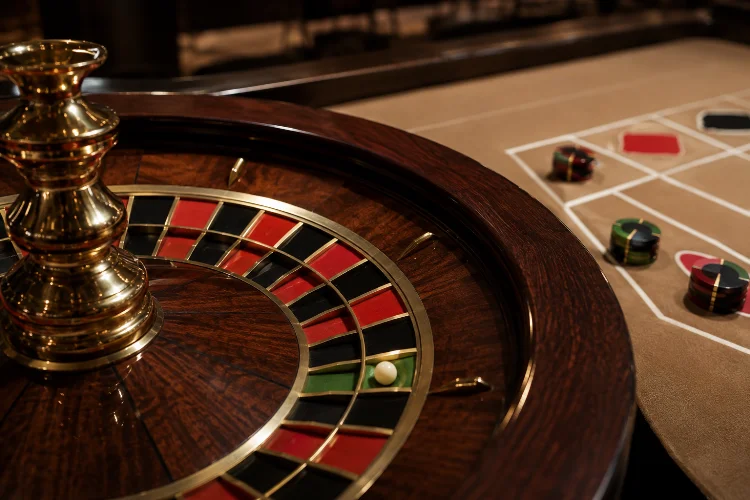
Roulette avoids most of these complications.
You place a fixed wager and the wheel determines the result. There are no later doubles, raises, or strategic decisions.
On standard double-zero American roulette, most wagers carry a 5.26% house edge. That corresponds neatly to a theoretical player return of approximately 94.74%.
On single-zero European roulette, the standard house edge falls to roughly 2.70%, producing an equivalent theoretical return of around 97.30%.
What is particularly interesting is that different bet types can have wildly different winning probabilities while sharing the same house edge.
Red pays 1:1 and wins approximately 47.37% of the time on double-zero roulette. A straight-up number pays 35:1 and wins only about 2.63%.
Both still carry the standard 5.26% edge.
This shows why house edge is about expected financial return – not how often you win.
Baccarat Shows How Paytables Change the Relationship
Baccarat provides another useful example because several wagers coexist in one game.
For a traditional eight-deck game with a 5% commission on winning Banker bets, Wizard of Odds gives approximate house edges of 1.06% for Banker and 1.24% for Player.
The corresponding theoretical returns are about 98.94% and 98.76%.
The standard 8:1 Tie wager has a much larger 14.36% house edge, equivalent to only around 85.64% theoretical return.
Now change the payout and the mathematics change too.
Wizard of Odds notes that a Tie wager paying 9:1 instead of 8:1 reduces the eight-deck house edge to about 4.84%.
The underlying probability of a tie has barely changed.
The payout changed, and therefore expected return changed.
This is why comparing side bets by prize size alone can be decieving.
House Edge Is Not the Same as Hold Percentage
Another term that sometimes causes confusion is casino hold.
House edge is a theoretical mathematical measure based on wagering.
Hold can refer to the casino’s actual revenue relative to money brought to the table, chips purchased, or another operational accounting base.
Imagine somebody buys $100 in chips and repeatedly wagers the same money until total betting turnover reaches $1,000.
A 5% theoretical edge applies to the $1,000 of wagers, not simply the original $100 buy-in.
That helps explain why a casino could theoretically earn more than 5% of a customer’s initial bankroll over an extended period even though the game has only a 5% house edge.
Repeated wagering creates additional exposure to the mathematical advantage.
Therefore, “5% house edge” should never be translated into “the casino can only take 5% of my deposit.”
RTP Does Not Tell You How Smoothly Returns Arrive
Two games can have identical RTP while producing radically different experiences.
A 96% slot might deliver many small prizes. Another 96% slot might concentrate a large portion of its theoretical return into rare bonus rounds or jackpots.
The headline RTP is the same.
The volatility is not.
The UK Gambling Commission states that theoretical RTP is averaged over a large number of games and that ordinary sessions can vary because of normal volatility.
This matters particularly when comparing slots with table games.
A roulette bet with a 97.30% theoretical return has a very simple distribution. A slot advertising roughly the same RTP may have thousands of possible outcomes and a completely different variance profile.
RTP is therefore useful for expected value, not for predicting the shape of a session.
Actual RTP Can Temporarily Move Above or Below Theory
Theoretical RTP describes design.
Actual RTP describes observed results.
A game theoretically designed to return 96% might show 91% actual RTP during one sample and 101% during another, especially when the samples are small or the game is highly volatile.
That does not automatically change the house edge of the mathematical model.
For British-regulated remote games, operators are expected to monitor actual RTP against expected RTP and detect both underpayments and overpayments.
The regulator recommends monitoring based on play volume and, where possible, automated alerts when results move outside expected tolerances.
So theoretical return remains the benchmark while actual results naturally fluctuate around it.
One player’s personal session is far too small to establish whether a game’s mathematical RTP has changed.
How to Compare Casino Games Properly
When you see RTP, first ask whether it is theoretical or observed.
When you see house edge, check whether it assumes optimal strategy and whether it is calculated against the initial wager or all money ultimately wagered.
Then check the specific paytable.
A blackjack table paying 6:5 on naturals can have a materially worse expected return than a seemingly identical table paying 3:2. Wizard of Odds estimates that changing blackjack payout from 3:2 to 6:5 adds about 1.39 percentage points to the house advantage under the comparison rules used.
Finally, consider volatility and game speed.
A slightly lower house edge does not guarantee lower short-term losses, and a fast game can expose more total money to that edge within the same hour.
Those details produce a much more useful comparision than ranking games from one headline percentage.
House Edge vs. RTP usually follows the simple relationship of 100% minus one equals the other, but only when both figures use the same wagering basis. Strategy, supplemental bets, paytables, and game structure can complicate that shortcut.
Compare definitions before comparing percentages, check the exact rules, and use RTP and house edge as long-term mathematical measures rather than predictions of your next result.