

Table Games

Table Games

How to Play Casino War: Ties, War Bets, and Card Rankings

Some casino games take several minutes just to explain. Casino War can be summed up in a sentence: you and the dealer each receive one card, and the higher card wins.

The interesting part begins when those cards match. Understanding How to Play Casino War therefore means learning two things: the simple card-ranking system and what happens during a tie.

Depending on the rules, you can surrender part of your wager or place more money on the table and go to War. This guide walks through the entire process without turning a very simple game into a maths lesson.

Casino War Uses Rank, Not Point Totals

Casino War does not ask you to add cards together.

Each card is judged only by its position in the standard ranking order. A 7 beats a 6, a queen beats a jack, and an ace beats a king.

Aces are high, while 2 is the lowest normal rank. Suits have no value when determining the winner.

This makes the game very diferent from baccarat, where individual card values are added, or blackjack, where an ace may count as one or eleven.

If you have the king of clubs and the dealer has the queen of hearts, you win because king outranks queen.

If both cards are kings, neither suit breaks the tie.

That matching rank activates the game’s special War rules.

Step-by-Step: How a Round Begins

Before any cards appear, you place a main Casino War wager.

An optional Tie side bet may also be available. This is a completely separate wager predicting that the first player card and dealer card will match in rank.

Once betting closes, one face-up card is dealt to each side.

If your card is higher, your initial wager generally pays 1:1. If the dealer has the higher card, the wager loses.

For example, imagine betting $25.

You receive a 10 and the dealer gets a 4. Your card wins, so a standard even-money payout provides $25 in winnings.

If the dealer instead gets a jack, your 10 loses.

Most rounds end at this point, making Casino War a particularly fast-paced table game.

The Surrender Option After a Tie

Suppose both you and the dealer receive a 6.

Instead of resolving the hand immediately, a typical Casino War game lets you surrender half your initial wager or continue into a War.

Surrender is the simpler choice.

If your original stake was $40, half is normally returned while the other $20 is forfeited.

The hand then ends.

Surrender can feel safer because you avoid putting additional money into the round. However, “safer” does not necessarily mean mathematically better.

Wizard of Odds’ six-deck analysis estimates a house edge of around 3.70% when always surrendering, compared with approximately 2.88% under its standard no-bonus rules when always going to War.

That comparision is based on a specific rule set, so another table can produce different figures.

What Happens When You Go to War?

Choosing War means adding another wager equal to your original stake.

If you originally bet $15, you generally need another $15 to continue.

The dealer then burns cards and deals another card to each side according to the applicable table procedure. In a common version, three cards are burned before the next cards are revealed.

Imagine your new card is an ace and the dealer receives a queen.

Your ace is higher, so you win the War.

Now imagine you receive a 5 and the dealer receives a king. The dealer wins, and both amounts you placed into action can be lost.

This is why players should understand that going to War increases the amount exposed during the round.

It is not simply a free second attempt.

What If the War Ends in Another Tie?

This is where checking the exact rules becomes especially important.

Different Casino War versions can treat a second tie differently.

Wizard of Odds notes that some casinos award an additional bonus when a tie occurs after the player has already gone to War. Under other rules, the settlement can be less generous.

State regulations also show real differences.

New York rules list a War wager payout of 2:1, increasing to 3:1 when the War deal itself produces a tie.

South Dakota’s published rules describe a related but differently expressed payout structure.

These examples explain why an online game, tribal casino, or regulated commercial casino may not use precisely the same wording or payouts.

The basic concept remains familar: matching initial cards trigger the War decision, but the settlement details should always be checked.

Understanding the Optional Tie Wager

The Tie side bet is settled from the first two cards.

If the ranks match, a common paytable awards 10:1. If they do not match, the Tie wager loses regardless of who wins the main hand.

Imagine you wager $10 on the main game and another $2 on Tie.

You receive a queen and the dealer also receives a queen.

The $2 Tie wager wins immediately at the posted payout, while your $10 main bet proceeds to the surrender-or-War decision.

This separation is important because winning the Tie wager does not automatically settle the main bet.

The large advertised payout can also hide a sizable house advantage.

With six decks and a 10:1 payout, Wizard of Odds calculates the Tie bet’s house edge at approximately 18.65%.

By comparison, its standard main-game calculation is much lower.

Why Rules Can Change the House Edge

Casino War may have simple gameplay, but its mathematics depend heavily on the payout rules.

The number of decks, treatment of second ties, War payouts, and Tie side-bet payout can all affect expected return.

For example, Wizard of Odds calculates roughly a 2.88% house edge for a six-deck no-bonus version when going to War. A more liberal version offering a bonus after another tie reduces its calculated edge to about 2.33%.

Some regulated jurisdictions also permit alternative Tie payouts.

That means seeing the words “Casino War” does not automatically tell you the exact odds.

Before playing, look for the paytable and check what happens after an initial tie, after a second tie, and on the optional side wager.

These details matter more than whether your previous few hands happened to win or lose.

Is There a Winning Casino War Strategy?

Casino War offers very little strategic control.

Unlike blackjack, you cannot choose how to play different card totals. You receive one card and compare it with the dealer.

The only major decision under standard rules is what to do after a tie.

For the standard six-deck rules analyzed by Wizard of Odds, going to War has a lower calculated house edge than surrendering.

However, that does not remove the casino advantage or guarantee a profitable session.

Increasing your wager after losses also does not improve card probabilities. A betting progression may change how quickly your balance moves, but it does not change which rank appears next.

Keeping betting limits clear is therefore more practical than trying to predict upcoming cards.

A Quick Example From Start to Finish

Imagine your initial bet is $10.

You receive an 8 and the dealer also gets an 8. The round ties.

You choose to go to War and place another $10.

After the required burn cards, you receive a king while the dealer receives a 9.

The king outranks the 9, so you win the War according to that table’s stated settlement rules.

If the new cards had both been kings, the second-tie payout would depend on the particular Casino War variation.

This example shows why card ranking itself is easy. The part worth reading carefully is the payment rule after ties.

Knowing How to Play Casino War comes down to three ideas: higher cards beat lower cards, aces are high, and matching ranks activate the tie procedure.

The main game is simple, but War payouts and Tie wagers can vary between tables.

Check the posted rules before playing, understand how much additional money a War requires, and compare payouts rather than assuming every Casino War game works identically.
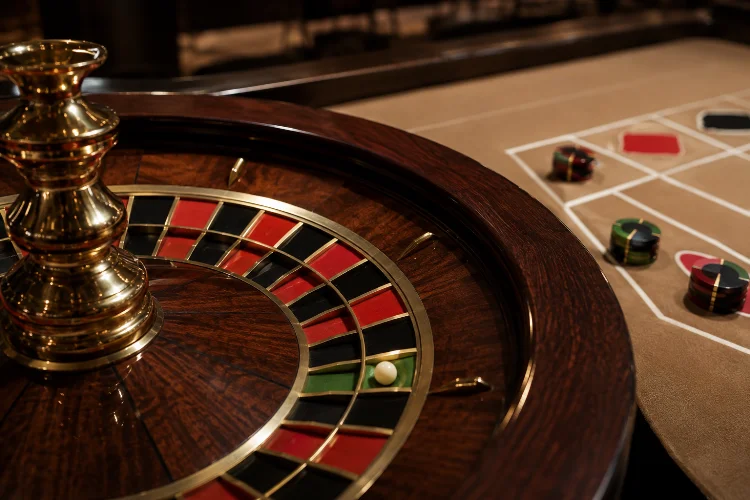

Table Games

En Prison and La Partage Rules: The Maths Behind the Lower House Edge

One green pocket is responsible for most of the mathematical tension in European roulette. Red covers 18 numbers. Black covers another 18. Without zero, the two sides would balance perfectly. The extra green pocket is what gives the casino its advantage.

En Prison and La Partage Rules do something unusual: they do not remove zero, change the wheel, or improve the odds of red or black appearing. Instead, they change the financial consequence when zero lands. That distinction is why French-style roulette can offer a lower house edge on even-money bets without changing the underlying probability of the wheel.

Sources describing French roulette commonly place the edge at approximately 1.35% on qualifying wagers compared with roughly 2.70% on ordinary single-zero roulette.

Why Zero Creates the Standard House Edge

A single-zero roulette wheel contains 37 possible outcomes.

For an even-money wager such as black:

18 outcomes win

18 outcomes lose to red

1 outcome loses to zero

The probability of winning is therefore:

18 ÷ 37 ≈ 48.65%

The probability of losing under ordinary rules is:

19 ÷ 37 ≈ 51.35%

Because a winning even-money wager pays only 1:1, the extra losing zero creates negative expectation.

For every $100 of theoretical turnover, the standard single-zero house edge of about 2.70% implies approximately $2.70 in long-run expected loss.

House edge represents an average rather than a guarantee for one session. The UK Gambling Commission defines it as the percentage a casino expects to keep on average from repeated casino play.

La Partage Does Not Change the Probability of Zero

An important point is often missed: La Partage does not make zero less likely.

The wheel still has:

1 zero among 37 pockets

The probability remains:

1 ÷ 37 ≈ 2.7027%

What changes is the cost of that outcome.

Instead of losing the full $1 even-money wager, you lose only $0.50.

PokerStars explains that under La Partage the stake is effectively divided when zero lands, with half returned to the player.

That turns the zero contribution to expected loss from:

1/37 × $1

into:

1/37 × $0.50

The effect is straightforward:

2.7027% ÷ 2 = 1.35135%

So La Partage produces an eligible-bet theoretical RTP of approximately:

98.64865%

Casino.org similarly lists French roulette with these special rules at about 98.65% RTP.

En Prison Changes Timing Rather Than Immediate Loss

En Prison arrives at almost the same long-term destination through a different mechanism.

If zero appears, the even-money wager does not immediately lose half its value.

Instead, the original wager stays on the table for another spin. PokerStars describes the stake as being placed “in prison,” with a qualifying win on the following spin releasing the imprisoned amount.

This creates delayed rather than immediate resolution.

Suppose $10 is imprisoned.

If the next qualifying spin wins, the $10 stake is returned without the normal $10 profit.

If the next spin loses, the $10 is forfeited.

With the common version where another zero keeps the stake imprisoned, the expected value of that locked wager works out to approximately -$5.

That is effectively the same average cost as immediately losing half under La Partage.

Why Repeated Zero Rules Deserve Attention

En Prison has one extra wrinkle that La Partage avoids.

What happens if zero lands again while the wager is already imprisoned?

There is no single procedure that can safely be assumed at every table. Reference material notes that casinos may treat another zero differently: the wager might remain imprisoned, lose, or be handled through another predefined rule.

That detail can slightly change the exact theoretical advantage.

For example, if an imprisoned bet loses entirely on a second zero instead of staying imprisoned, the house edge becomes slightly higher than the classic 1.351% figure.

The difference is small, but advanced roulette comparision should not ignore it.

The published game rules should always be treated as the final authority.

The Advantage Is Limited to Three Bet Families

The lower edge applies only to wagers paying even money.

Those are normally:

Red or Black

Eighteen red numbers oppose eighteen black numbers.

Odd or Even

Eighteen odd numbers oppose eighteen even numbers.

Low or High

Numbers 1–18 oppose numbers 19–36.

Zero belongs to none of these groups.

PokerStars confirms that the special rules generally do not apply to straight-up numbers, splits, streets, dozens, or columns.

So it would be inaccuratte to say that French roulette universally has a 1.35% edge on every wager.

The benefit depends on bet type.

Quantifying the Strategic Difference

Consider two tables.

Table A is ordinary single-zero roulette.

Table B uses La Partage on even-money bets.

Assume a player generates $5,000 of eligible turnover.

Expected theoretical cost at Table A:

$5,000 × 2.7027% = $135.14

Expected theoretical cost at Table B:

$5,000 × 1.35135% = $67.57

The rule difference reduces theoretical expected loss by roughly:

$67.57

That is not a prediction for the player’s actual balance. Short-term outcomes can move far above or below expectation.

The Gambling Commission notes that actual RTP can differ noticeably from theoretical RTP with limited play and tends to become more representative as the number of games increases.

Still, when repeated enough, paying less for zero is mathematically relevent.

Why This Matters More Than Betting Progressions

Many roulette systems focus on changing the wager after wins or losses.

Martingale doubles after losses.

Other progressions change stakes after wins.

None changes the wheel from 37 pockets to 36.

La Partage and En Prison are fundamentally different because they alter the payoff rule, not merely the staking sequence.

Expected value depends on outcome probabilities and associated payoffs. NIST defines expected value through the probability-weighted values of possible outcomes.

Changing the zero payoff therefore genuinely changes EV.

Changing a staking pattern usually changes exposure and variance instead.

That distinction is one of the most pratical lessons in roulette strategy.

The Best Rule Still Has Negative Expectation

Cutting the edge from 2.70% to 1.35% is meaningful, but it does not cross zero.

The casino still holds the mathematical advantage.

A lucky player can finish ahead.

Another can lose much more than the expected amount during a short session.

Neither result disproves the underlying percentage.

For strategic comparison, the rules simply answer a narrower question:

If you are already choosing an even-money roulette wager, which rule structure creates the lower mathematical cost?

Between ordinary single-zero roulette and an otherwise equivalent table offering favourable La Partage or En Prison treatment, the special rule is mathematically better.

It is lower-cost gambling, not guaranteed profitable gambling.

En Prison and La Partage Rules lower the expected cost of qualifying roulette bets because zero no longer creates a full-stake loss. La Partage settles immediately, while En Prison delays the outcome, but both can reduce the classic edge to about 1.35%.

Check repeated-zero rules and eligible bets carefully, then compare tables using expected value rather than betting-system claims.

Table Games

Roulette Wheel Bias: From Pocket Frequencies to Sector Analysis

Record twenty roulette spins and the results almost always look uneven. A few numbers may repeat, one section of the wheel might appear unusually active, and perhaps red dominates for a while. None of that is surprising. Random sequences rarely look perfectly balanced over short samples.

The difficult part of analysing Roulette Wheel Bias is separating ordinary statistical noise from persistent physical behaviour. A mechanical wheel is expected to produce outcomes that are acceptably random, but real equipment can theoretically develop imperfections through alignment, wear or other physical conditions.

The UK Gambling Commission therefore highlights ongoing integrity measurements of roulette wheels and says long-term result distributions can be examined for acceptable randomness.

The strongest analysis does not chase one “hot number.” It examines pockets, physical sectors, time periods and repeatability together.

A Fair Wheel Still Produces Uneven Counts

On a European roulette wheel, every pocket theoretically has probability:

p = 1/37 ≈ 0.0270

After 1,000 spins, the expected count per pocket is approximately:

1,000 / 37 ≈ 27

But “expected” does not mean guaranteed.

One number might appear 19 times while another appears 35.

That difference can happen naturally.

Even huge random samples retain some irregularity. An analysis published by the Royal Statistical Society’s Significance showed that fair roulette simulations produced apparently dramatic streaks, including repeated numbers and extended runs of the same even-money outcome.

This is the first lesson of wheel analysis:

random does not mean evenly alternating.

Any detection method that labels ordinary clusters as bias will generate endless false alarms.

Frequency Analysis Builds the Basic Picture

The simplest analysis counts how often every pocket appears.

Suppose 37,000 European-wheel results are available.

A perfectly balanced expectation would be:

37,000 / 37 = 1,000 observations per pocket

Imagine the recorded results show:

Number A: 1,012
Number B: 978
Number C: 1,006
Number D: 1,184

Number D clearly deserves attention.

But visual inspection is only a starting point.

Analysts need to ask whether the difference between observed and expected counts is statistically plausible under the fair-wheel hypothesis.

A chi-square goodness-of-fit test is a natural tool for this kind of categorical distribution. Penn State even demonstrates the method using roulette probabilities as an example.

The test combines deviations across all categories rather than declaring one number suspicious simply because it looks large.

Statistical Significance Depends on the Sample

Imagine one pocket should theoretically appear 2.7% of the time.

In 100 spins, that means an average of only 2.7 occurrences.

Seeing it six times might look impressive, but the sample is tiny.

If the same pocket repeatedly appears around 4% across 100,000 spins, the evidence becomes far more interesting.

This relationship is fundamental to statistical power.

Small differences are difficult to distinguish from random variation without enough observations. Larger effects can become visible much sooner.

That is why regulators emphasise extended-period monitoring for physical roulette output rather than using short gaming sessions as integrity tests.

The ideal sample size is not one fixed number such as 5,000 or 10,000 spins.

It depends on how small a deviation analysts want to detect and how much statistical certainty they require.

Bias May Follow Wheel Geography Rather Than Number Labels

A very important step is converting results into physical wheel order.

On a European wheel, numbers are deliberately arranged in a non-sequential pattern.

That means numerical neighbours such as 14 and 15 can be far apart physically.

If a wheel is slightly tilted or a component behaves unevenly, the resulting effect may favour a physical region rather than a collection of numerically related values.

Small and Tse investigated a standard casino-grade European roulette wheel and found statistically significant physical effects in experiments, including pronounced bias produced by a very slight slant.

This suggests a second analysis:

instead of only testing individual pockets, group neighbouring physical pockets into sectors.

A wheel might show no spectacular single-number anomaly while seven adjacent pockets collectively appear more frequently than expected.

Sector analysis can reveal patterns that pocket-by-pocket testing misses.

Mechanical Bias and Random Clustering Look Similar at First

Suppose six neighbouring pockets perform unusually well for 2,000 spins.

There are two broad explanations:

the wheel has a physical tendency toward that area, or randomness simply created a temporary cluster.

You cannot reliably choose between them from one short dataset.

Kavokin, Sheremet and Petrov mathematically studied non-ideal roulette in terms of small deviations between pocket probabilities and described how such deviations can cause numbers to “bunch” compared with an ideal model.

The important word is persistent.

Random clustering tends to move around.

A physical bias should show some consistency until the underlying condition—such as alignment or equipment state—changes.

That makes repeated sampling essential.

Split the Data Instead of Trusting One Big Test

Suppose investigators collect 20,000 spins.

Running one statistcal test on all 20,000 can identify an interesting pattern, but it does not show whether that pattern is stable.

A more informative approach is to divide the observations.

For example:

first 10,000 spins → discovery sample

second 10,000 spins → validation sample

If a suspected sector is identified in the first sample and independently remains abnormal in the second, the evidence becomes stronger.

If it disappears, the first result may have been random or overfitted.

Martínez used 10,980 spins from a real European roulette feed and employed backtesting and walk-forward concepts when analysing the dataset, reinforcing the general importance of evaluating whether historical patterns continue outside the sample used to discover them.

This is a much stronger methodology than endlessly searching the same dataset for something unusual.

Beware the “Hot Number” Multiple-Testing Trap

Imagine analysing all 37 European pockets individually.

Then test 37 two-pocket combinations.

Then dozens of wheel sectors.

Then red, black, odd, even, high and low.

Then repeat everything by dealer, hour and weekday.

Eventually, something will generate a low p-value by accident.

This is the multiple-testing problem.

Penn State’s statistical guidance notes that significance levels need adjustment when multiple comparisons are made because otherwise the overall false-positive rate becomes inflated.

This issue is especially dangerous with roulette because the dataset provides so many possible patterns to explore.

An analyst who searches first and invents the hypothesis afterwards can almost always find something that looks remarkable.

A stronger approach defines the test before looking at the validation sample.

That makes the resulting measurment far more credible.

Wheel Bias Should Be Separated From Operational Effects

Suppose a particular table shows unusual sector clustering.

Before concluding the wheel itself is defective, analysts should consider other variables.

Did the effect remain after dealers changed?

Did it remain after the wheel was inspected?

Did it survive repositioning or maintenance?

Did the same physical sector continue to overperform?

These questions help distinguish wheel-specific behaviour from other operational conditions.

The Gambling Commission notes that fairness in live roulette is influenced by equipment supply, installation, continuing operation and dealing processes—not simply the wheel considered in isolation.

Its testing framework also explicitly identifies biased live-dealer equipment or flawed dealer procedures as integrity risks requiring independent assurance.

This makes statistical monitoring most useful when accompanied by good operational records.

Physical Investigation Provides the Second Half of the Answer

Suppose statistical analysis repeatedly identifies the same physical sector.

That is evidence worth investigating.

It still does not identify the mechanical cause.

Small and Tse’s roulette experiments demonstrate that physical geometry can matter: they reported that even slight tilt could have a pronounced effect on outcome distribution.

Other potential mechanical issues can only be evaluated through inspection and controlled testing.

In regulated live gaming, this is why integrity is not based purely on a spreadsheet.

The Commission states that physical roulette provision is surrounded by controls relating to equipment installation, continuing operation and integrity measurement.

Statistics acts as an alarm system.

Engineering and operational examination determine what caused the alarm.

A Significant Bias Is Not Automatically a Predictive System

There is an important final distinction.

Detecting that probabilities are not perfectly uniform does not mean individual spins become predictable.

Imagine a pocket’s true probability rises from roughly 2.70% to 2.85%.

That could become statistically detectable with enough observations, but any specific spin remains highly uncertain.

Likewise, a physical sector could be slightly favoured without receiving the ball on anything close to most spins.

Statistical bias changes a probability distribution.

It does not reveal the next outcome.

Research into non-ideal wheels shows that small physical departures from uniformity can matter mathematically, but the size and persistence of the effect determine whether it has practical significance.

That is why statistical significance and practical significance should always be evaluated seperately.

Reliable Roulette Wheel Bias detection combines pocket frequencies, sector analysis, adequate sample sizes and out-of-sample validation. A strange streak or hot number means little on its own because fair randomness naturally produces clusters.

Persistent deviations across independent datasets deserve deeper investigation, especially when they align with physical wheel geography. Use statistical testing as an integrity tool, then confirm suspected anomalies through equipment and operational checks.

Table Games

Casino Poker Variants Every Player Should Know Before Playing

Selecting a casino poker game can be confusing for beginners because many tables use the same hand rankings but very different procedures.

A player who understands standard poker may recognize a flush or full house yet still misunderstand when the dealer qualifies, how much a raise costs, or why one wager is returned while another loses.

The easiest way to compare Casino Poker Variants Every Player Should Know is to consider three questions. How many cards must be evaluated? Does the player compete against the dealer or a fixed paytable? How much additional money may be required after the initial wager?

Using these questions reveals why Three Card Poker is usually easier to learn than Pai Gow, why Ultimate Texas Hold’em feels familiar but has unusual betting stages, and why Mississippi Stud can create greater exposure than its small Ante suggests.

This beginner-focused guide explains the most recognizable variants while highlighting terminology, decision points, and common misunderstandings. Exact payout schedules vary, so never rely entirely on rules remembered from another casino.

Three Card Poker: The Fastest Starting Point

Three Card Poker reduces the game to three cards for the player and three for the dealer. Players can use an Ante to compete against the dealer, a Pair Plus wager to play against a paytable, or both where the rules permit.

After reviewing the cards, an Ante player either folds or adds a Play wager equal to the Ante. The dealer commonly needs Queen-high to qualify. The three-card ranking order is straight flush, three of a kind, straight, flush, pair, and high card.

The limited hand size makes the game approachable, although players must still distinguish the main wager from optional bonuses.

Ultimate Texas Hold’em: Familiar Cards, Different Betting

Ultimate Texas Hold’em uses two hole cards and five community cards, making the final hand-building process familiar to Hold’em players. However, it is a house-banked game rather than a contest among several participants.

Players begin with matching Ante and Blind wagers. They can make one Play bet during the round: three or four times the Ante before the flop, twice the Ante after the flop, or once the Ante after all community cards are visible. Waiting provides more information but reduces the available wager size.

Terms such as flop, turn, river, hole cards, and community cards carry their usual meanings, but bluffing has no role because every player independently faces the dealer.

Caribbean Stud: Five Cards and One Clue

Caribbean Stud gives five cards to every player and the dealer. One dealer card is shown before players decide whether to fold or continue.

Continuing requires an additional Bet equal to twice the Ante. The dealer then reveals the remaining cards and must hold at least Ace-King to qualify. If the dealer qualifies, standard five-card hands are compared.

This game may feel closer to traditional five-card stud, but players cannot exchange cards. The visible dealer card is information for the fold-or-play decision, not the beginning of another betting round.

Pai Gow Poker: The Hand-Setting Challenge

Pai Gow Poker gives the player seven cards from a deck that usually contains a joker. Those cards must be divided into a five-card high hand and a two-card low hand.

The five-card group must outrank the two-card group. Both player hands must beat the dealer’s corresponding hands to win. One victory and one defeat result in a push, while ties normally go to the dealer.

Important terms include house way, the casino’s fixed method for arranging the dealer’s cards, and foul hand, an illegal arrangement in which the low hand is stronger than the high hand. Beginners uncertain about arranging cards can commonly request a house-way setting.

Let It Ride: Withdrawing Wagers

Let It Ride begins with three equal bets. The player receives three cards, and the dealer controls two community cards that will complete every player’s hand.

The unusual feature is the ability to remove one wager before the first community card and another after that card is revealed. Bets that remain active are settled after the second community card appears. A pair of tens is commonly the minimum winning hand.

“Let it ride” simply means leaving the eligible bet in action. It does not improve the cards or activate a multiplier.

Mississippi Stud: Building a Bet by Street

Mississippi Stud also combines private and community cards, but its wagering direction is opposite to Let It Ride. Instead of beginning with several bets and withdrawing them, the player starts with an Ante and may add money before each community card.

The player receives two cards and decides whether to fold or place a Third Street bet of one to three times the Ante. Similar choices precede the next two community cards. The final five-card hand is paid from a schedule, with no dealer hand involved.

The terms Third Street, Fourth Street, and Fifth Street describe the staged community-card decisions. Players should calculate the potential cost of all three before starting.

Base Bets Versus Side Bets

A base wager determines participation in the central game. Side bets provide separate payouts for events such as a pair, three of a kind, a six-card combination, or a progressive jackpot.

Bonus wagers do not necessarily follow the same qualification or folding rules as the main game. Some remain active after a base-game fold, while others do not.

The payout displayed for a side wager may also use “to one” rather than “for one,” affecting whether the original stake is returned.

Always read each betting area independently. A familiar name such as Trips or Pair Plus does not ensure that every casino uses the same payout table.

How Beginners Should Choose

Start with the game whose basic decision can be explained in one or two sentences. Three Card Poker offers the fewest cards, while Caribbean Stud has one primary fold-or-play choice. Ultimate Texas Hold’em requires more betting-stage knowledge but uses familiar community-card mechanics.

Pai Gow is suitable for players willing to learn hand arrangement. Let It Ride and Mississippi Stud are easier to understand once players recognize that they compete against paytables rather than dealer hands.

Begin without optional side wagers where possible. This keeps the first rounds easier to follow and makes the total cost clearer.

Every casino poker variant combines familiar cards with its own betting language. Three Card Poker emphasizes speed, Ultimate Texas Hold’em uses staged raises, and Caribbean Stud centers on one exposed dealer card.

Pai Gow divides seven cards into two hands, Let It Ride permits wager withdrawals, and Mississippi Stud adds bets as community cards appear.

Before sitting down, learn the dealer qualification requirement, minimum winning hand, continuation amount, and maximum total exposure.

Keep optional bonuses separate from the base game and never assume a previous losing hand changes the next deal. Set a daily budget and playing-time limit before beginning, as responsible-gambling guidance recommends.

Table Games

Baccarat for Beginners: Essential Terms and Table Etiquette

A baccarat table can sound unfamiliar even when the underlying game is simple. Dealers may announce a natural, collect commission, open a new shoe, or describe a result as a push.

Online menus add names such as mini-baccarat, speed baccarat, EZ Baccarat, and no-commission baccarat. Learning this language is an important part of any Baccarat for Beginners: Rules, Bets, and Terminology guide.

Knowing what the terms mean helps players follow each round, read the pay table, and recognize when a variation changes the normal payouts. It can also prevent the common mistake of assuming that “Player” means the person gambling or that “Banker” always represents the casino.

Terminology does not provide a way to predict future cards. Baccarat is a chance-based game in which standard drawing decisions are handled automatically.

The purpose of learning the vocabulary is to understand what is happening and what is being wagered. Any real-money participation should remain within local law, age restrictions, and a predetermined entertainment budget.

Player, Banker, and Tie

Player and Banker are the names of the two competing hands. A customer may wager on either hand regardless of where they are seated.

A Tie occurs when the two final totals are equal. Tie bets are separate wagers, while ordinary Player and Banker bets are generally pushed when the hands finish equal.

The objective is to predict which hand will end closer to nine. Participants are not trying to defeat a dealer hand in the same manner as blackjack.

Punto Banco, Mini-Baccarat, and Midi-Baccarat

Punto banco is the widely played casino form in which both hands follow fixed drawing rules. Players choose a wager but do not decide whether the hands receive additional cards.

Mini-baccarat uses the same core rules in a faster, more compact format. Cards are normally dealt face up by the dealer, and participants do not handle them.

In midi-baccarat, the highest bettor on a hand may sometimes touch and slowly reveal the cards. This practice is known as a squeeze. It adds ceremony and suspense but does not change the card values or outcome.

Shoe, Round, and Deal

A shoe is the holder from which multiple shuffled decks are dealt. Online live-dealer games may use a physical shoe, automatic shuffler, or a combination of dealing technology and studio equipment.

A round, sometimes called a hand or coup, begins when wagers close and ends after the cards are compared and bets are settled.

The initial deal normally gives two cards to Player and two to Banker. The first and third cards belong to Player, while the second and fourth belong to Banker. Any additional card is determined by the third-card table rather than personal choice.

Natural, Stand, and Draw

A natural is an initial two-card total of eight or nine. When at least one hand has a natural, the dealing normally stops and the totals are compared.

To draw means that a hand receives an additional card. To stand means that it receives no more cards.

Player draws with totals from zero through five and stands with six or seven. Banker’s action may depend on Player’s third card. In standard online and mini-baccarat, the dealer or software applies these instructions automatically.

Commission, Even Money, and Push

Even money means a successful wager earns profit equal to the original stake. A $25 Player win at even money earns $25.

Traditional Banker wins also begin with an even-money calculation, but the casino commonly deducts a 5% commission. A $25 Banker win would therefore produce $23.75 in profit.

A push returns the wager without profit or loss. Standard Player and Banker wagers usually push when the hands tie. In EZ Baccarat, a three-card Banker win totaling seven can also push the ordinary Banker wager.

Third-Card Rule and Tableau

The third-card rule is the fixed procedure that determines whether Player or Banker receives one additional card. It is sometimes presented as a chart called the tableau.

The Player side is simple: draw on zero through five and stand on six or seven. Banker draws on zero through two regardless of Player’s third card. With totals of three through six, Banker’s action may depend on the value Player received.

New players can consult the chart, but they do not need to make the drawing decisions themselves. The value of the rule is understanding why the dealer sometimes gives a card to one hand and not the other.

Side Bets and Special Terms

A Player Pair or Banker Pair wager concerns whether the first two cards on the selected side have the same rank. These bets are independent of which hand ultimately wins.

A Dragon 7 is a winning three-card Banker hand totaling seven in EZ Baccarat. A Panda 8 is a winning three-card Player hand totaling eight. These terms can refer both to special outcomes and optional wagers.

Other games may use names such as Perfect Pair, Lucky Six, Super Six, or Dragon Bonus. Their definitions are not universal, so the table’s own help screen remains the authoritative guide.

Scoreboards, Roads, and Streaks

Baccarat scoreboards record previous outcomes. Common displays use colored circles or grid patterns to show sequences of Player and Banker wins.

These histories can be useful for following the table, but they do not establish that a streak must continue or reverse. Baccarat is classified as a game of chance, and previous outcomes do not provide player control over the next deal.

A betting progression based on a road map may change stake sizes, but it cannot remove the casino’s mathematical advantage.

Basic Live-Table Etiquette

Place wagers before the betting timer closes and avoid asking the dealer to change an automatically determined drawing decision. When card handling is permitted, follow the dealer’s instructions and keep cards above the table.

Do not assume that every baccarat table uses identical commission or side-bet rules. Review the information panel before entering a live game, especially when the title includes “speed,” “no commission,” “EZ,” or “Super Six.”

Set the stake and session limit in advance. GameSense recommends understanding the odds, taking breaks, avoiding loss-chasing, and playing for entertainment rather than expected income.

Baccarat terminology becomes manageable once the terms are grouped by purpose. Player, Banker, and Tie describe the possible wagers.

Natural, draw, stand, and tableau explain the dealing process. Commission, even money, and push describe how bets are settled, while punto banco, mini-baccarat, and EZ Baccarat identify different formats.

Read the table rules whenever moving to a new variation because familiar terms can carry modified payout conditions. Do not use scoreboards or streaks as predictions, and never raise stakes simply because one result appears overdue.

Begin with small, affordable wagers, follow the dealer’s instructions, and stop when the planned entertainment budget or time limit is reached.