
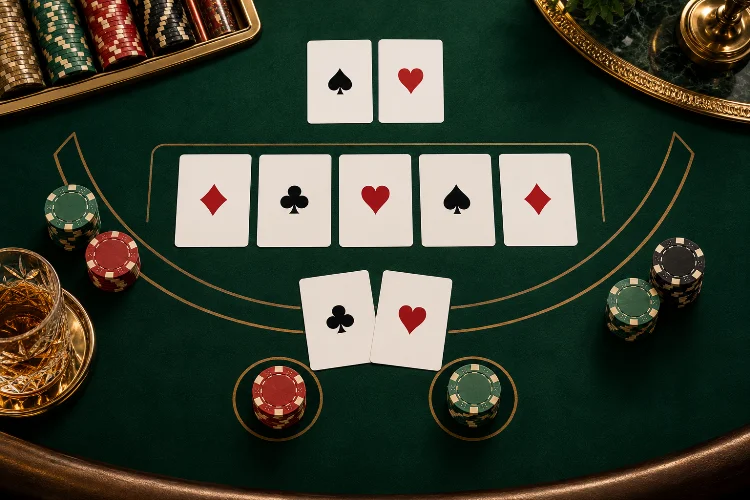
How to Play Casino Hold’em: Hands, Payouts, and Smart Decisions
You may already know what a pair, straight, or flush looks like, but Casino Hold’em adds a few twists that can make familiar poker situations behave differently.
The dealer must qualify, your Call costs twice the Ante, and premium hands can receive special payouts.
This guide to How to Play Casino Hold’em looks beyond the basic deal and explains what actually determines whether your wagers win.
We will cover community cards, poker hand comparison, dealer qualification, Ante payouts, side bets, house edge, and practical ways beginners can make more informed decisions.
Casino Hold’em Is Not Regular Texas Hold’em
Both games use two hole cards and five shared community cards, so they initially look almost identical.
The major difference is your opponent.
In Texas Hold’em poker, you compete with other players and can use betting pressure or bluffing. Casino Hold’em removes that element entirely. You are playing a fixed game against the house dealer.
There are no pre-flop raises, re-raises, or attempts to make the dealer fold.
Instead, you place an Ante, receive two cards, see the flop, and make one decision: Call or Fold.
How the Flop Changes Your Decision
The flop consists of three face-up community cards dealt before your Call/Fold decision.
That means you already see five of your potential seven cards before deciding whether to commit more money.
Imagine your hole cards are 9♠-8♠ and the flop shows 10♠-7♦-2♠.
You do not currently have a strong made hand, but the situation has considerable potential. A jack or six could contribute to a straight, while another spade could eventually help complete a flush.
Compare that with holding 3♣-2♦ on a flop of A♠-K♥-9♣. Your cards are low, unpaired, and poorly connected to the board.
Understanding these draw possibilities is more useful than looking only at the hand you have right now.
Why the Call Bet Matters So Much
Calling is not a small continuation wager.
It normally costs exactly twice your original Ante.
With a $20 Ante, folding costs $20. Calling requires another $40, increasing total money committed to $60.
That 2x structure is the main reason the decision deserves attention.
Beginners sometimes make the opposite mistakes: calling virtually everything because they want to see the final cards, or folding too many hands because the flop did not immediately produce a pair.
Neither approach reflects how the mathematics of the game works.
How the Turn and River Complete the Hand
If you Call, two final commnity cards are dealt.
These are the turn and river, bringing the board to five cards.
Your final poker hand is the strongest five-card combination that can be built from the seven cards available to you. The dealer does exactly the same thing with their own two private cards and the shared board.
Sometimes the board itself creates nearly the entire hand.
For example, if the board contains K-K-8-8-A, everyone already has at least two pair. Your private cards may matter only as a kicker if they improve on the ace – or they may not improve the board at all.
This is why knowing basic Texas Hold’em hand construction remains useful.
Why the Dealer Must Qualify
Before comparing the two hands normally, the dealer’s hand is checked against a minimum requirement.
The standard qualifier is a pair of fours or better.
A pair of threes is not enough. A pair of fours qualifies. Any stronger pair, two pair, straight, flush, or better hand also qualifies.
When the dealer does not quailfy, the Call bet normally pushes and is returned. The Ante is then paid according to the game’s stated payout schedule.
When the dealer qualifies, the stronger five-card hand determines the result.
This rule is central to Casino Hold’em because the dealer can fail to qualify even when your own final hand is relatively weak.
How Ante and Call Payouts Differ
Your two main wagers serve different purposes.
The Call normally pays 1:1 when you beat a qualifying dealer. The Ante can pay according to the strength of your hand.
A common Ante table pays even money for ordinary hands up through a straight, 2:1 for a flush, 3:1 for a full house, and 10:1 for four of a kind.
Straight flushes and royal flushes can pay substantially more.
Suppose you place a $10 Ante and later make the required $20 Call. If you finish with a qualifying flush and beat the dealer under a table paying 2:1 for a flush, the Ante receives its enhanced payout while the Call is settled separately at even money.
Always verify the paytabe because some implementations use different premium-hand payouts.
Understanding the AA Bonus Side Bet
The optional AA Bonus introduces another way to wager on the cards.
Instead of waiting for all seven cards, this bet commonly evaluates the first five cards available to you – your two hole cards plus the three-card flop.
A pair of aces is normally the minimum qualifying combination.
A frequently used structure pays 7:1 for a pair of aces through several lower premium combinations, then offers larger returns for flushes, full houses, four of a kind, straight flushes, and royal flushes.
However, the maths of the side bet is independant of the main game.
Wizard of Odds documents AA+ paytables with house edges ranging from about 2.97% to more than 6%, depending on the version.
This is a useful reminder that identical-looking side bets can have significantly different mathematical value.
What Does the House Edge Look Like?
For a commonly analyzed Casino Hold’em paytable, the main game has a house edge of about 2.16% per Ante when played optimally.
That figure should not be interpreted as losing exactly $2.16 every time you wager $100.
House edge is a long-term theoretical measure calculated across enormous numbers of rounds.
Short sessions can produce results far above or below the mathematical expectation.
The figure also assumes good decision-making. Folding hands that should be called – or repeatedly making poor continuation decisions – can make actual expected results worse.
A Practical Way to Think About Strategy
Perfect Casino Hold’em strategy is not as easy as memorizing “pair or better.”
Analysis published by Wizard of Odds suggests an optimal player Calls around 82% of hands and folds only the weakest 18%.
The weaker situations generally involve low hole cards that miss the flop badly and have little straight or flush potential.
For beginners, three questions are helpful before folding: Do I already have a made hand? Do my cards create a realistic straight or flush draw? Do my hole cards meaningfully improve the board?
None of these questions guarantees the mathematically correct choice in every situation, but they help prevent the common mistake of folding automatically whenever the flop looks disappointing.
If you want precise optimal decisions, use a strategy chart designed for the exact rules and Ante payout schedule you are playing.
Common Beginner Mistakes
The first mistake is confusing Casino Hold’em with ordinary player-versus-player poker. There is no benefit to bluffing because the dealer follows fixed rules.
Another is forgetting that the Call costs twice the Ante. A seemingly modest base stake can therefore create much larger total exposure.
Players can also misunderstand dealer qualification and assume they automatically win both wagers whenever the dealer fails to qualify. Under common rules, the Call pushes while the Ante follows its payout table.
Finally, treat the AA Bonus as a seperate wager. A strong-looking side-bet payout does not change the probability structure of the main Ante/Call game.
Understanding How to Play Casino Hold’em means looking beyond familiar poker cards and learning how the casino-specific rules fit together.
Your most important choice comes after the flop, while dealer qualification and separate Ante payouts determine how winning hands are settled.
Learn standard hand rankings, compare the actual table rules and bonus payouts, and use a fixed budget so the game remains entertainment rather than a chase for guaranteed results.