
Inside Live Casino Studios: How Real-Time Game Synchronisation Works
A player watching live blackjack might see a card hit the table and its value appear on the digital interface almost immediately. Seconds later, another card arrives, the total updates, betting controls change, and eventually the hand is settled. Everything feels like one continuous event.
Technically, it is not. Live Casino Studios combine physical dealing, video production, data capture, network communication, player inputs, account transactions, and monitoring systems. Those components must behave like one coordinated platform even though they perform very different jobs.
Regulators require live dealer operations to remain fair and independently auditable, while specialist testing laboratories evaluate technical performance and synchronicity.
The result is a surprisingly sophisticated real-time infrastructure hiding behind a simple betting interface.
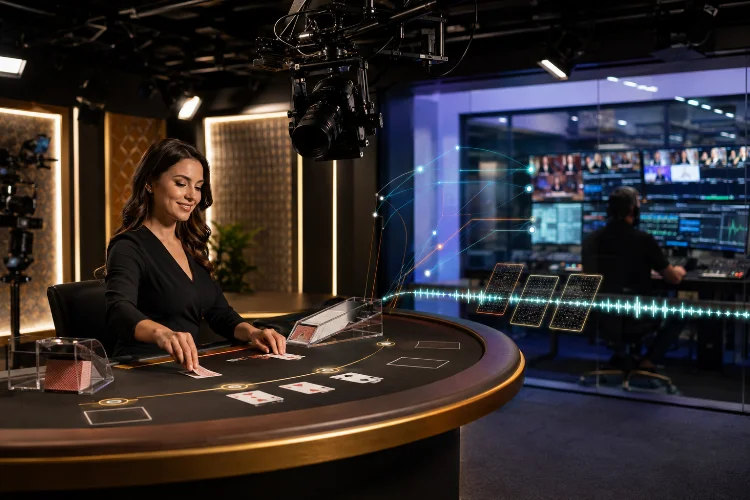
The Studio Acts Like a Broadcast Facility and Data Centre
A professional live casino environment shares characteristics with both television production and transaction-processing infrastructure.
The broadcast side includes dealers, cameras, lighting, microphones, physical tables, and production equipment.
Evolution’s studio products demonstrate how far that broadcast side can go. Its live roulette offerings use multiple cameras, while some dedicated live environments are built specifically around individual operators and brands.
But video alone cannot run the game.
The digital layer must also process bets, identify rounds, distribute game states, record outcomes, calculate settlements, and maintain player-account information.
These jobs need to remain tightly coordinated.
The studio is therefore not merely “a casino being filmed.” It is a hybrid physical-digital system.
One Round Exists in Several Places at Once
Take a baccarat round.
Physically, cards are being dealt at a studio table.
On the server, a corresponding game round has an identifier and current status.
On the player’s device, betting controls and a video stream represent that same round.
Inside transaction systems, individual wagers are linked to it.
Operational monitoring systems may also be recording the event.
The challenge is keeping all of these representations consistent.
If the studio moves to a new round while a backend component still thinks the previous round is active, mistakes become possible.
This is why synchronicity appears as a distinct testing category in GLI’s live dealer evaluation process.
The real technical achievement is not simply processing events quickly. It is ensuring every layer agrees about which event is currently happening.
Betting Deadlines Need an Authoritative Clock
A countdown timer can look like a cosmetic interface element.
Operationally, it represents an important boundary.
Before the cutoff, eligible wagers can be submitted.
After the cutoff, the game needs to reject wagers for that round.
This becomes tricky because players connect through networks with different latency.
One user may have a fast fibre connection. Another may be using mobile data. Video buffering can also differ between devices.
The visible video cannot therefore serve as the sole authority for deciding whether a wager arrived in time.
Backend systems generally need an authoritative game state that determines whether betting is open or closed.
The player’s interface then reflects that state as accurately as practical.
This avoids a scenario where two players see slightly different video timing and therefore receive different interpretations of the betting deadline.
Good synchronisation separates visual timing from transactional authority.
Latency Cannot Be Removed, Only Managed
No internet-connected system has literally zero latency.
Signals need time to travel from the studio to servers and onward to players.
Video encoding adds processing time.
Decoding adds more.
Player commands then have to travel back in the opposite direction.
The goal of live casino architecture is therefore not the impossible target of eliminating latency completely.
The goal is to make latency predictable enough that it does not undermine the integrity of the round.
Video buffering, server-controlled betting states, and carefully sequenced game events can help create that experience.
GLI’s inclusion of synchronicity testing reflects the importance of this relationship between timing and game integrity.
Even very polished live tables still depend on carefully managed delays.
They simply hide that complxity well.
Result Recognition Connects Physical Play to Settlement
After betting closes, the physical game must produce an outcome.
That outcome needs to become a digital value.
In roulette, software ultimately needs a winning number.
In baccarat, it needs the relevant card data and final player, banker, or tie result.
In blackjack, it needs accurate hands and game decisions.
Different providers can use different combinations of table technology, dealer interfaces, recognition systems, and control equipment.
What matters from an infrastructure perspective is that the physical outcome cannot remain purely visual.
A structured result is required before automated settlement can happen.
The system also has to know that the result belongs to the correct round.
That relationship between physical equipment and digital systems is one of the areas covered by live dealer technical evaluation and regulatory requirements for auditable operations.
Result Validation Comes Before Money Movement
A live dealer raises their hands, the roulette ball stops, or the final card is revealed.
From the player’s perspective, the game may seem finished.
For the backend, another step remains.
The system has to confirm the result and apply it to recorded wagers.
This separation is important because settlement changes account balances.
A mistake at this stage could affect many users simultaneously on a high-capacity table.
Platforms therefore benefit from treating outcome detection and financial settlement as related but distinct stages.
The outcome establishes what happened.
The settlement engine determines how that event affects individual bets.
That separation also makes troubleshooting easier.
If the result itself is correct but an account transaction is not, engineers can investigate the settlement layer rather than questioning the physical table.
This modular structure is considerably more managable at scale.
Surveillance Supports Dispute Resolution
Broadcast footage and structured data are useful, but live operations also need independent supervision.
UK Gambling Commission guidance states that video surveillance should record dealer activity with sufficient detail to confirm whether dealing procedures and game rules were followed.
This becomes particularly valuable when a round is disputed.
Imagine a card being dealt incorrectly or a physical object obscuring part of the table.
The platform may have transaction logs and digital game-state records, but surveillance provides another source of evidence.
A robust investigation can compare these different records.
Did the dealer follow procedure?
What outcome did the digital system capture?
Which wagers were accepted?
What settlement was applied?
Combining those records produces far more reliable oversight than relying on any single source.
Monitoring Helps Detect Desynchronisation Early
Synchronisation problems do not always cause a dramatic outage.
Sometimes they appear as smaller abnormalities.
A data feed may lag.
One table may stop reporting events.
Video might remain active while the game state stops progressing.
Operational monitoring systems need to identify these mismatches before they create a larger problem.
This is one reason live dealer evaluations extend beyond the visible gameplay and examine systems, premises, technical operation, staffing, and synchronicity.
A studio running dozens or hundreds of concurrent tables cannot depend entirely on people noticing that something looks unusual.
Automated monitoring can help surface exceptions.
The table can then be paused or investigated according to the provider’s procedures.
In other words, synchronisation is not just something designed into the platform.
It also has to be continually observed.
Scaling Makes Synchronisation Harder
Running one live blackjack table is one problem.
Running many blackjack, baccarat, roulette, and game-show tables for numerous operators and markets is another.
Evolution publicly offers dedicated studio environments and operator-specific tables, illustrating how live dealer infrastructure can expand into multiple customised environments.
At that scale, every game needs separate round identifiers, video sources, betting states, results, and transactions.
Yet the wider platform must still manage them through consistent operational systems.
The easiest way to make this scalable is through modular architecture.
A problem on Table 14 should ideally remain a Table 14 problem instead of disrupting every other table.
Separating table-level systems while connecting them to shared platform services makes this isolation more practical.
It also makes expansion less disruptive when new tables or studios are introduced.
Malta’s regulator, for example, specifically treats the addition of new games and live studios as a technical approval matter for licensees.
Live Casino Studios work because video, betting, physical outcomes, and financial transactions are coordinated as separate but connected systems. Latency is managed rather than eliminated, while authoritative game states keep each round organised.
When evaluating live casino technology, look beyond picture quality. Reliable synchronisation, validation, monitoring, and auditability are what make real-time digital play possible at scale.